

Physical verification is the process of confirming that assets recorded in the register actually exist, are where they should be, and are in the stated condition. It produces evidence — a dated, signed record of what was checked and what was not found — and it is the only thing that converts a register into assurance.
Physical verification is what turns a register from a set of claims into something you can defend. It's also the step that gets pushed to next quarter more than any other, because everyone assumes it means a week of stopping work.
It doesn't have to mean either of those things, and I've sat on both sides of enough of these to be fairly confident about that.
What physical verification is
Physical verification of fixed assets is the process of confirming, by direct observation, that the assets recorded in the register exist, are located where the register says, and are in the recorded condition.
It answers three distinct questions, and it's worth separating them because they fail differently:
|
Question |
Failure mode |
What it usually means |
|---|---|---|
|
Does it exist? |
Recorded but not found |
Disposed without closing, lost, or never received |
|
Is it where we think? |
Found elsewhere |
Movement not recorded — a process gap, not a loss |
|
Is it as described? |
Condition or spec differs |
Degradation, substitution, or a bad original record |
Planning the verification
- Define the scope precisely — a site, a category, a department, a cost centre. Write down what is excluded as well as what is included.
- Extract the expected list from the register as at a stated date, so the comparison has a fixed baseline.
- Decide the evidence standard. Is sighting the asset enough, or must the tag be scanned and the serial matched? Scanning is stronger and, on a phone, faster.
- Assign counters who are not the custodians of what they are counting, where you can. Independence matters to whoever reviews the result.
- Agree how to handle in-transit items — equipment issued to someone, out for repair, or at another site. These are not discrepancies if you can show where they are.
Running it
Walk the scope and record each item as you go. The critical discipline is recording at the point of checking rather than transcribing afterwards, because transcription is where errors enter and where the timestamp stops being real.
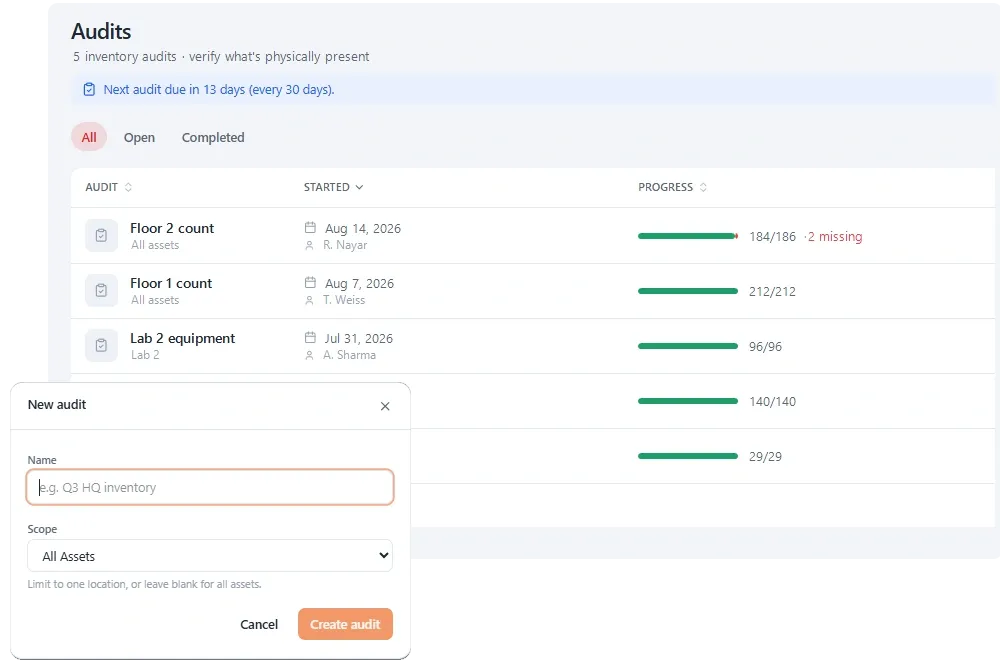
*Each item recorded verified or missing as the count proceeds, with progress and discrepancies visible throughout.*
Record found-but-not-expected items too. Equipment present and not on the register is as much a finding as the reverse, and it's frequently how untracked purchases surface.
The evidence it must leave
- The scope and the baseline date of the expected list.
- The counter's identity and a sign-off at close.
- A per-item result: verified, not found, or found unexpectedly.
- Notes against individual items where condition or location differed.
- A reconciliation showing how each discrepancy was resolved.
- An export in a form the requester can file without reformatting.
Handling discrepancies
Don't correct the register during the count. Record what you found, close the count, then reconcile — otherwise the evidence of the discrepancy disappears into the correction, and the audit trail shows a clean count that never happened.
|
Finding |
Resolution |
Register action |
|---|---|---|
|
Found in a different location |
Movement was not recorded |
Update location; investigate the process gap |
|
In someone's custody |
Issued but not recorded, or recorded and not scanned |
Record custody; review issue process |
|
Out for repair |
Legitimate, if evidenced |
Link the maintenance record |
|
Not found anywhere |
Write off after a defined search period |
Mark lost with last-seen date and location |
|
Found, not on register |
Untracked purchase or transfer in |
Add, with acquisition details if recoverable |
Sampling, when a full count isn't realistic
Sometimes the estate is too large or too dispersed to verify completely in any useful timeframe. Sampling is a legitimate answer, provided it's designed rather than improvised.
|
Method |
How it works |
Best for |
Weakness |
|---|---|---|---|
|
Full count by scope |
Everything in one location or category |
Most organisations |
Nothing — this is the default |
|
Random sample |
A fixed percentage chosen at random |
Very large estates |
Says nothing about any specific location |
|
Risk-weighted |
Everything above a value or risk threshold |
Mixed estates |
Low-value losses stay invisible |
|
Rolling cycle |
Each scope counted once per year on rotation |
Multi-site |
Needs discipline to keep the rotation |
Whichever you choose, write down the method before you start. A sample described after the fact looks like the parts that were convenient, whether or not it was.
Tagging gaps found during verification
Every first verification finds equipment with no tag, an unreadable tag, or a tag belonging to a record that was retired years ago.
Resist fixing these mid-count. Note them, finish the count, then work the list — otherwise the count takes three times as long and you lose track of what was verified versus what was repaired.
- No tag, on the register — match on serial, tag it, note the gap.
- No tag, not on the register — a found asset. Add it with whatever acquisition detail survives.
- Tag unreadable — reprint against the existing record; the history is intact.
- Tag on a retired record — the disposal was never closed. Fix the disposal, not the tag.
What the report should say about what you couldn't check
This is the section people leave out, and it's the one that makes the rest credible.
State plainly what was out of scope, what was inaccessible on the day, and what was accepted on documentary evidence rather than sight. A report claiming complete verification of an estate that includes equipment in twelve vans and three engineers' homes will be read sceptically, and rightly.
Frequency
Annual verification of the whole estate is the common requirement. Achieving it through rolling cycle counts scoped by location or department is almost always better: the same coverage, spread across the year, with discrepancies found while they're still recoverable.
High-value or high-risk categories can justify a shorter cycle. Set that by consequence rather than by value alone — a cheap item whose absence stops a job may matter more than an expensive one in a cupboard.
Key takeaways
- Physical verification confirms existence, location and condition by direct observation — it is what converts a register into assurance.
- Fix the scope and baseline date before starting, and state what is excluded.
- Record results at the point of checking; transcribing afterwards introduces errors and destroys the timestamp.
- Record found-but-not-expected items — untracked purchases surface this way.
- Do not correct the register mid-count. Close first, then reconcile, or the evidence disappears into the fix.
Frequently asked questions
What is physical verification of fixed assets?
The process of confirming by direct observation that assets in the register exist, are where the register says they're, and are in the recorded condition — producing dated, signed evidence of what was checked and what wasn't found.
How often should physical verification be carried out?
Most organisations need annual coverage of the estate. Rolling cycle counts scoped by location or department achieve the same coverage without losing a week, and find discrepancies while they're still recent enough to resolve.
Who should carry out physical verification?
Someone other than the custodian of the assets being counted, where the organisation is large enough to allow it. Independence matters to whoever reviews the result, and self-verification is the first thing a reviewer will question.
What happens if an asset can't be found?
Record it as not found rather than correcting the register, close the count, then run a defined search period. If it remains missing, mark it lost with the last-seen date and location, and keep the finding attached to the asset so the pattern is visible across audits.
Can physical verification be done with barcode or QR scanning?
Yes, and it's both faster and stronger evidence than sighting alone. Scanning a tag records the verification against a specific unit at a specific time, rather than relying on somebody ticking a line that matches a description.