

An employee equipment agreement records what was issued, to whom, when, in what condition, and on what terms — signed by the person receiving it. Its value is less in the document than in the moment: people treat equipment differently once they have consciously accepted responsibility for it.
Nearly every organisation I speak to has one of these somewhere. It's usually a Word template. It gets filled in sometimes, signed occasionally, and filed in a folder nobody can locate during the exact conversation it was written for.
So here's what it should contain — and, more usefully, what makes one actually work rather than just exist.
What the agreement has to record
|
Field |
Why it is there |
|---|---|
|
Item identification |
Asset tag, make, model and serial. 'A laptop' identifies nothing. |
|
Holder |
A named individual, not a team or a department. |
|
Date issued |
The start of the custody period, and the anchor for everything after. |
|
Condition at issue |
The before half of any damage conversation. |
|
Accessories included |
Chargers, docks, cases, cables — the items most often unreturned. |
|
Expected return |
A date where one applies, so overdue means something. |
|
Terms |
Care, reporting loss or damage, personal use, return on request or departure. |
|
Signature |
Evidence of acceptance rather than an assertion of it. |
Accessories deserve their own line. A laptop comes back because it's obviously valuable and obviously company property. Three chargers, two docks and a headset don't, and in aggregate they're frequently the larger loss.
The terms worth stating
Keep them short. An agreement nobody reads because it runs to two pages is worse than four clear clauses people actually absorb.
- Care. The holder takes reasonable care of the equipment and uses it for its intended purpose.
- Reporting. Loss, theft or damage is reported promptly, and reporting is not penalised — you want to hear about it early.
- Personal use. Whether it is permitted, and any limits. Silence here causes more disputes than any other omission.
- Return. The equipment is returned on request, on role change, or on leaving, in working order allowing for fair wear.
Deliberately absent: a clause making the employee automatically liable for replacement cost. Depending on jurisdiction, deducting from wages may be unlawful without specific consent, and an unenforceable clause weakens the rest of the document. Take advice on your own jurisdiction before including anything of that kind.
Why the signature matters more than the document
This is the part that sounds procedural and isn't.
A record in a database is an administrative fact the person it concerns may never see. A signature is a moment in which somebody consciously accepted responsibility for something valuable. People behave differently about things they have signed for, and that behavioural difference is the actual return on the process. The document is evidence; the moment is the mechanism.
Which means when it's signed matters enormously. A form completed later, by someone else, from memory, produces a document and none of the effect.
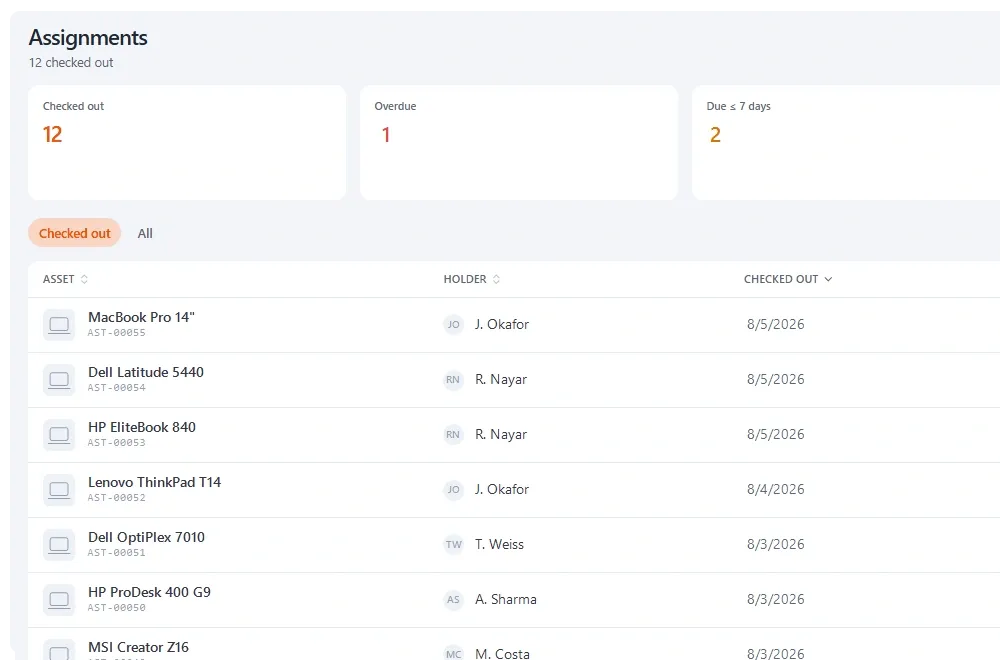
*Issued to a named person, signed on the device at the moment of handover, with the agreement generated automatically.*
Making it happen every time
Paper agreements fail for predictable reasons: the template isn't to hand, the printer is elsewhere, the signed copy is filed where nobody looks, and nobody can produce the list of what a given person holds without reading every file.
- Capture it at the point of handover, on the device already in the issuer's hand, rather than afterwards at a desk.
- Generate the document automatically from the custody record, so the agreement and the register cannot disagree.
- Send the holder a copy. People who have the list treat the contents differently from people who do not.
- Keep it queryable by person, so 'what does Priya currently hold' is a view rather than a search through a folder.
- Capture condition on return too, because an agreement that records only the issue half cannot settle a damage question.
Deciding which items need a signature
Requiring a signature for everything is the fastest way to get signatures for nothing — the friction lands on people who see no benefit, and they route around it.
|
Tier |
Treatment |
Examples |
|---|---|---|
|
High value or high risk |
Signed agreement, condition recorded both ends |
Laptops, instruments, power tools, keys |
|
Moderate |
Custody recorded, no signature |
Monitors, docks, radios, hand tools |
|
Shared pool |
Booking plus custody, no signature |
Loan laptops, meeting room kit |
|
Location-only |
Counted periodically, no holder |
Furniture, fixed equipment |
Set the boundary at a value you would genuinely chase. If nobody would pursue a missing £40 item, a signature on it's theatre.
Remote and hybrid staff
Equipment sent to a home address has no handover moment, which is where the whole mechanism normally lives. Three things restore it:
- Acknowledgement on receipt — the recipient confirms what arrived, which also catches courier shortfalls while they are still disputable.
- An explicit list including accessories, because a home worker accumulates chargers and docks nobody recorded.
- A return method agreed in advance, ideally at issue. Deciding how equipment comes back after somebody has resigned is too late.
Where the agreement usually falls down
|
Failure |
What it looks like |
Fix |
|---|---|---|
|
Signed late |
Filled in days after the handover, from memory |
Capture at the point of handover, on a phone |
|
Accessories omitted |
'One laptop' with no mention of the dock or chargers |
List every item, however trivial |
|
No condition recorded |
Damage disputes become opinion |
Record condition at issue and at return |
|
Filed, not queryable |
Nobody can list what a person holds |
Generate from the custody record, not a document store |
|
Never closed |
Custody stays open after return |
Check-in closes the record and the agreement |
Reviewing holdings periodically
People accumulate. Somebody who joined three years ago has a laptop, a replacement laptop nobody collected, two docks, a phone, and a monitor from an office move.
An annual holdings review — send each person their list and ask them to confirm it — catches this while it is still recoverable and costs almost nothing. It also surfaces the items people forgot they had, which is most of them.
Tie it to something that already happens, like an appraisal cycle or the start of the financial year. A standalone task competing with real work will not survive its second year.
What to do when equipment isn't returned
- Ask, clearly and early. A surprising proportion is simple forgetfulness, and the list often jogs the memory.
- Send the signed agreement with the outstanding items marked. People respond differently to a document they signed.
- Offer a return method. Prepaid postage recovers more equipment than escalation does.
- Escalate through HR, not directly. Wage deduction is restricted in many jurisdictions and is not a step to take informally.
- Record the loss with the last-seen date so the pattern is visible, and close the custody rather than leaving it open forever.
How it connects to offboarding
The agreement's real payoff arrives at departure. If every issue was recorded against the person, the leaver's holdings are a generated list, recovery is a checklist, and a clearance certificate can be produced and signed when everything is back.
Without it, offboarding equipment recovery becomes an investigation conducted during the week there's least time for one — which is why departures are consistently the most concentrated source of unrecovered equipment.
Key takeaways
- Record the item, holder, date, condition, accessories, expected return, terms and a signature.
- List accessories explicitly — chargers, docks and cables are the items most often unreturned.
- Keep terms to four short clauses; take local advice before any liability or wage-deduction wording.
- The signature at the moment of handover is the mechanism; the document is only the evidence.
- Generate the agreement from the custody record so it can be queried by person at offboarding.
Frequently asked questions
What should an employee equipment agreement include?
Item identification including serial and asset tag, the named holder, the issue date, condition at issue, accessories, an expected return date where one applies, short terms on care, reporting, personal use and return, and a signature from the person receiving it.
Is a digital signature valid for an equipment agreement?
In most jurisdictions an electronic signature is acceptable for an agreement of this kind, and a record showing an authenticated user accepted a specific item at a specific time is generally stronger evidence than an unattributed scrawl on paper. Confirm the position for your own jurisdiction.
Can we charge employees for lost equipment?
This depends entirely on local employment law, and deducting from wages is restricted or prohibited in many places without explicit prior consent. Take advice rather than copying a clause from a template. A good agreement records responsibility; enforcement is a separate legal question.
Do we need an agreement for every item?
Not necessarily. A sensible split is signed agreements for high-value or portable equipment issued to individuals, recorded custody without a signature for lower-value shared items, and location-only tracking for things that live in a place rather than with a person.
What happens to the agreement when an employee leaves?
It becomes the recovery checklist. Everything the person holds should be listed from their record, checked back in with a condition note, and the outstanding items chased while they're still contactable. A clearance certificate closes it once everything is returned.
Do we need a new agreement each time equipment is issued?
A record each time, yes, but it should be generated rather than written. Each issue creates its own custody record with its own signature, and the person's current holdings are the sum of the open ones — which is what you need at offboarding.
What should happen if an employee refuses to sign?
Record the handover anyway, noting that it was unsigned. The alternative is no record at all, which is worse. An unsigned handover in the history is itself informative, and a pattern of them points at something worth understanding.
Can equipment agreements be part of the employment contract?
They can reference it, and many do. Keeping the item-level record separate is still worth it, because the contract sets the terms once while the record has to change every time something is issued or returned.