

Remote working removes the handover — the moment somebody physically accepts responsibility for something valuable. An acknowledgement on receipt restores it, an explicit accessory list keeps it honest, and agreeing the return method at issue is what makes recovery possible months later.
We went hybrid over about six weeks, like everyone else, and I spent the following year discovering what that had done to our equipment records.
The short version: we had a register that assumed somebody handed a thing to somebody else. Once a courier was doing that instead, roughly nothing in the process survived.
What the handover was actually doing
I hadn't thought about this properly until it was gone. Handing equipment to someone across a desk does three things at once, and only one of them is obvious.
- It creates a record — the obvious one.
- It creates a moment, where the person consciously registers that this is theirs to look after. People treat things they've accepted differently. That's most of the behavioural value.
- It creates a shared understanding of what was included — they watched you put the dock and both cables in the box.
A courier delivery gives you none of the three. A box arrives, they open it, and nobody has agreed anything.
What replaces it
|
What the handover did |
Remote equivalent |
Why it works |
|---|---|---|
|
Created a record |
Issue recorded at despatch |
Same record, made earlier |
|
Created a moment of acceptance |
Acknowledgement on receipt |
They confirm what arrived, which is an act rather than a delivery |
|
Established what was included |
Explicit accessory list in the confirmation |
Also catches courier shortfalls while they're disputable |
|
Set expectations about return |
Return method agreed at issue |
Deciding this after someone resigns is far too late |
That third row earns its place twice. You'd be surprised how often something is genuinely missing from a box, and how quickly that stops being anyone's problem if nobody checks in the first week.
Accessories, and why they're worse remotely
In an office, surplus equipment accumulates visibly. Somebody notices a desk with three monitors.
At home nobody notices anything. A dock from the first setup, a second monitor from the upgrade, a keyboard that arrived with a replacement laptop, two chargers because one lived in a bag. None of it feels like company property, all of it is, and none of it is written down anywhere.
Listing accessories explicitly at issue is the single highest-return habit for a distributed team. It costs nothing, and it's the difference between recovering a laptop and recovering a laptop plus four hundred pounds of peripherals.
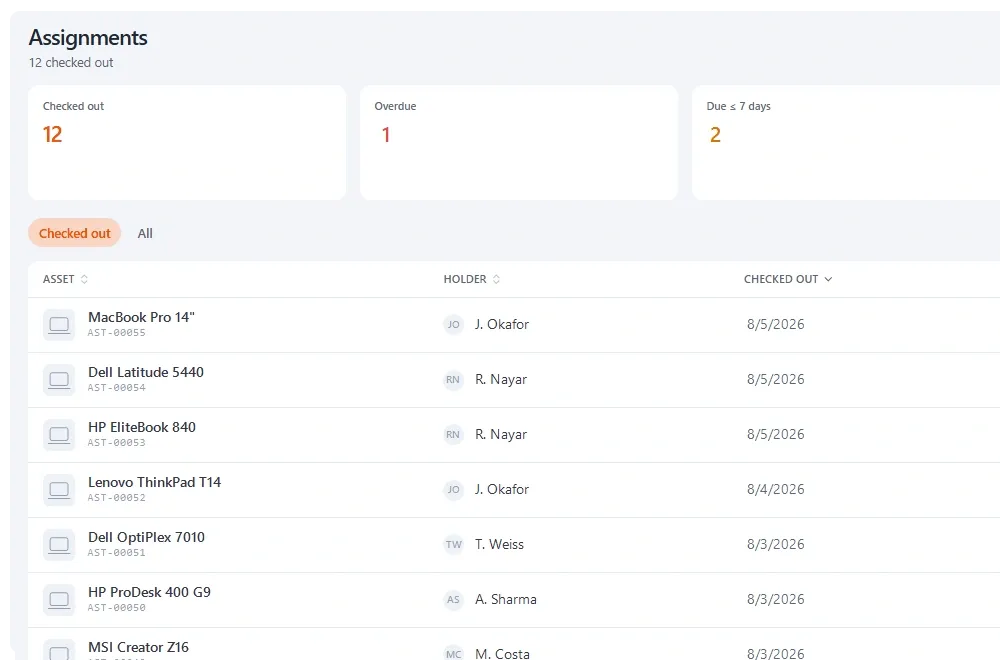
*Issued against a name with the full list, so the record covers what was actually sent.*
The annual acknowledgement
Nobody can count a distributed estate physically, so the honest substitute is asking.
Once a year, send each person the list of what they hold and ask them to confirm it. It takes them two minutes, it catches accumulation, and it corrects the register. It's weaker evidence than a physical count and you should label it as such in any report — but against a register nobody has verified in three years it's transformative.
Tie it to something that already happens. A standalone task competing with real work will not survive its second year.
Getting equipment back
This is where remote hurts most, because the leaver has your equipment and no reason to come to an office.
- Agree the return method at issue. Prepaid label, courier collection, whatever — decided when it goes out, not when they resign.
- Send the list early, while they're still working their notice and still replying to messages.
- Make returning easy. Prepaid postage recovers more equipment than escalation does, by a wide margin. The friction is the problem, not the intent.
- Escalate through HR, not directly, and take advice before anything involving pay. Wage deduction is restricted in many places.
- Close the record either way. An open custody against a person who left two years ago is noise in every count you run afterwards.
Don't forget the office half
Hybrid means two estates, and the office one gets neglected because it feels like the solved problem.
It isn't. Hot-desk monitors, docks at shared desks, meeting-room equipment and the spares cupboard have no holder at all, which means nobody is accountable between counts. They need location-based tracking and a periodic count, not custody — and trying to force a signature onto a hot-desk monitor is how people conclude the system is silly.
|
Equipment |
Model |
Verification |
|---|---|---|
|
Issued to a person, at home or a desk |
Custody with a holder |
Acknowledgement or check-in |
|
Hot-desk peripherals |
Location only |
Periodic count of the floor |
|
Meeting-room AV |
Location only |
Periodic count, plus warranty tracking |
|
Spares cupboard |
Location, with status |
Count and triage quarterly |
Deciding which model applies to what, once, is most of the work. Registers go stale in hybrid organisations mostly because nobody made that decision and everything ended up half-assigned.
Key takeaways
- A courier delivery removes the moment of acceptance, which is where most of the behavioural value lived.
- An acknowledgement on receipt restores it and catches courier shortfalls while they're still disputable.
- List accessories explicitly — at home nobody notices accumulation, and it outvalues the laptop.
- Agree the return method at issue; deciding after someone resigns is too late, and prepaid postage beats escalation.
- Hybrid is two estates: custody for issued equipment, location-only plus counts for hot-desk and meeting-room kit.
Frequently asked questions
How do you track IT equipment for remote employees?
Record the issue against the person at despatch with a full list including accessories, then ask them to acknowledge receipt. That acknowledgement is the remote equivalent of a signature at a desk and is what makes the record evidence rather than an assertion.
How do you get equipment back from remote leavers?
Generate the list from their record, send it while they're still working their notice, and make returning genuinely easy — prepaid postage or booked collection. Most non-returns are friction rather than intent, and removing the friction recovers more than chasing does.
Should remote employees sign for equipment?
An acknowledgement on receipt serves the same purpose and is more realistic. It records that a named, authenticated person confirmed what arrived on a specific date, which is what you'd want to show if it's ever disputed.
How do you audit equipment you can't physically see?
Send each person their list annually and ask them to confirm it. It's weaker than a physical count and should be described as what it is, but against an estate nobody has verified in years it finds a great deal.
How do you track hot-desk equipment?
By location rather than by holder, with a periodic count of the floor. Monitors and docks at shared desks have no sensible owner, and assigning one to satisfy the system makes the record less true rather than more.
What about equipment in a home that's damaged?
Record the fault from wherever they are, which opens a ticket and takes the item out of circulation. Whether you repair, replace or collect is then a decision with a record behind it rather than an email thread.