


An asset audit checklist covers four phases: plan the scope and freeze movements, count blind against tags rather than ticking a printed list, resolve every discrepancy as missing, found, wrong location or wrong custodian, then correct the register, post write-offs to the ledger and keep a dated record of who counted what.
The walking-round part of a physical inventory count is the easy bit. What makes a count useful is the planning before it and the reconciliation after it, and those are the parts that get rushed.
If you're the operations or IT lead, finance manager or facilities person who has just been asked to run one, this is for you. It covers a full count and a rolling cycle count, explains where sampling fits, and ends with a printable checklist you can work through. For the step-by-step mechanics in Stackroom specifically, see how to do an asset audit.
What a count proves, and in which direction
A count tests two things, and each one runs in a different direction.
Existence runs from register to floor. You pick records from the register and go and find the physical asset, which catches ghost assets (records for things you no longer have). Completeness runs the other way, from floor to register. You pick physical assets and look for their record, which catches untagged or unrecorded equipment. That matters for insurance and security and, if the item is capitalisable, for your balance sheet.
Working only from a printed register, you'll find missing items but never unrecorded ones. Scanning only what is in front of you finds the unrecorded items, but it can't tell you what is missing until you compare. So plan for both directions from the start.
What the 'ghost asset' numbers actually say
You will see claims that 15% to 30% of assets on a typical register do not exist. Be careful before you repeat them. A 2019 Accounting Today opinion piece attributes the 15 to 30 percent figure to Gartner but gives no study title, year or methodology, and the original research is not publicly traceable. A December 2025 article from Kroll's fixed asset advisory practice repeats a range of 10% to 30% of assets on the average register no longer existing, and up to 65% of records being incomplete or inaccurate, attributing them to unnamed studies.
Treat these as widely repeated industry estimates, mostly from firms that sell asset verification, rather than measured facts. Nobody knows your number until you count. The first count after a long gap usually finds more than people expected, which is reason enough to do one.
Phase 1: plan and scope
Write the scope down before anyone picks up a scanner. If the scope is vague, nobody can say afterwards what the count covered, and so nobody can rely on the result.
- What is in scope: which locations, asset classes and value bands. Exclude explicitly rather than by omission.
- The register snapshot: export the register for the scope on the day before the count and keep it, because it is what you are testing against.
- Cut-off: decide what happens to issues, returns, transfers and disposals during the count. Either freeze them, or record each one with a timestamp so you can reconcile.
- Who counts: where the organisation is large enough, the person counting a location should not be the person responsible for it. Pairs work well: one finds and scans, one records.
- Tags and access: make sure counters can get into every room and cupboard, and have spare tags for untagged items they find.
- Assets with people: decide how you will verify laptops and kit held by remote or travelling staff, for example a scheduled scan of the tag or a photo of the serial plate.
Phase 2: count blind
In a blind count, your counters record what they find without being shown what they should find. Hand someone a list and ask them to tick it, and they will tick. People tick items they assume are there, especially late in the day.
So ask counters to scan or write down every asset in the location, with its tag, description, serial if the tag is missing, condition, and anything odd. You compare against the register afterwards, and the differences are the output. If you are using a scanning app, the equivalent is scanning everything present rather than working down a pre-loaded checklist.
Record the location where each item was actually found. That one habit turns 'missing from Room 4' and 'unexpected in Room 6' into a single wrong-location finding instead of two problems.
Sampling: when you don't count everything
Your external auditor will often test a sample rather than every asset, and you can borrow the same logic for interim checks. The PCAOB's AS 2315, Audit Sampling, defines audit sampling as applying an audit procedure to less than 100 percent of the items in a balance or class, to evaluate a characteristic of the whole. It recognises sampling risk: the chance that a conclusion from the sample differs from the one you would reach by testing everything.
The international standard, adopted in the UK as ISA (UK) 530, adds two points you can use directly in an internal count. Every sampling unit in the population should have a chance of selection. And the selection methods include random selection, systematic selection (every nth item from a random start) and haphazard selection, though haphazard selection is not appropriate for statistical sampling. The standard also allows high-value or key items to be selected specifically rather than sampled.
Here is how that translates into a practical approach for your own checks. It is not an auditing standard, so don't present it to an auditor as one.
- Count every high-value or high-risk asset in scope in full: servers, specialist instruments, anything above a value line you set.
- Sample the rest at random or systematically from the register, and separately sample from the floor for completeness.
- If the sample finds more problems than you would tolerate, stop sampling and count that location in full.
Full count or cycle counts?
A full count covers everything at once. A cycle count covers one location, department or asset class at a time, on a rolling schedule, so that everything is covered over a period. Both are legitimate, and the choice comes down to where you want the effort to fall and how quickly you want to find problems.
|
|
Annual full count |
Rolling cycle counts |
|---|---|---|
|
Effort |
Concentrated: days of disruption once a year |
Spread: a few hours per location, regularly |
|
Discrepancy age when found |
Up to 12 months |
Up to the length of the cycle |
|
Chance of tracing a missing item |
Lower; memories have faded |
Higher; often still recoverable |
|
Point-in-time assurance |
Strong for one date |
Weaker for any single date; stronger over the year |
|
Risk of slipping |
High; one big event is easy to postpone |
Lower if scheduled into routine |
You may already have a minimum set for you. US recipients of federal awards must conduct a physical inventory of equipment and reconcile the results with property records at least once every two years under 2 CFR 200.313(d)(2), which is relevant to US universities and research institutions. US public companies need controls that give reasonable assurance of timely detection of unauthorised use or disposition of assets, under the SEC's definition of internal control in Release 33-8238; a regular count is one of the plainest ways to show that.
Our longer comparison of asset audit requirements covers what different reviewers expect to see from each approach.
Phase 3: resolve every discrepancy
Every difference the count throws up needs a classification, an owner and an outcome. A count that ends with an unexplained 'missing: 23' has cost a day and changed nothing.
|
Discrepancy |
What it usually means |
What to do |
Evidence to keep |
|---|---|---|---|
|
Missing (on register, not found) |
Lost, stolen, disposed of without a record, or with a person |
Check custody records, ask the last holder, search adjacent locations; if still missing after a set period, write off |
Search notes, last known location and holder, approval for write-off |
|
Found (found, not on register) |
Bought without being recorded, or returned and never re-added |
Tag it, trace the purchase, add it at cost if capitalisable |
Photo, serial, invoice or reason it cannot be traced |
|
Wrong location |
Moved without the move being recorded |
Update location; look for the process gap |
Old and new location, date found |
|
Wrong custodian |
Handed between people informally |
Reassign to the actual holder and get an acknowledgement |
Who actually held it and since when |
|
Wrong status |
Broken, retired or disposed of but still shown as active |
Update status; start disposal if needed |
Condition notes, disposal record |
Then look at where the discrepancies cluster. If most of the missing items are in one office or one category, you know where the process broke, and that is worth more than the total.
Investigate lost and stolen equipment before anything is deleted. For federally funded equipment, 2 CFR 200.313(d)(3) requires that any loss, damage or theft be investigated and, where it affects the programme, reported to the awarding agency.
Phase 4: reconcile to the register and the ledger
Correcting the register does not correct the accounts. Once the discrepancies are resolved, work through these steps in order.
- Update the register for every location, custodian and status change, with the count date as the reason.
- For assets confirmed missing or disposed of, record the disposal: date, method (lost, stolen, scrapped), proceeds if any, and carrying amount at that date. Under UK FRS 102 an asset is derecognised on disposal or when no future economic benefits are expected from it, and the gain or loss is proceeds less carrying amount (FRS 102, paragraphs 17.27 to 17.30); IAS 16 is to the same effect (BDO summary).
- For found assets that meet your capitalisation policy, add them at cost with the correct in-service date, or document why cost cannot be established.
- Post the resulting journals and agree register totals by class to the general ledger after the adjustments.
- Write a short summary: scope, date, counters, items verified, discrepancies by type, write-offs, and process fixes agreed.
If the write-offs are material, involve whoever prepares the accounts before posting, because the timing and presentation may matter for the period. For depreciation on the remaining assets, the depreciation calculator is a quick way to check carrying amounts.
Evidence to keep
Keep the count pack with the year's accounting records: the register snapshot, the raw count data, the discrepancy log with outcomes, approvals for write-offs and the summary. You'll be holding it for years. In the US, the IRS says to keep records relating to property until the period of limitations expires for the year in which you dispose of it. GOV.UK says UK limited companies must keep accounting records for six years from the end of the financial year they relate to.
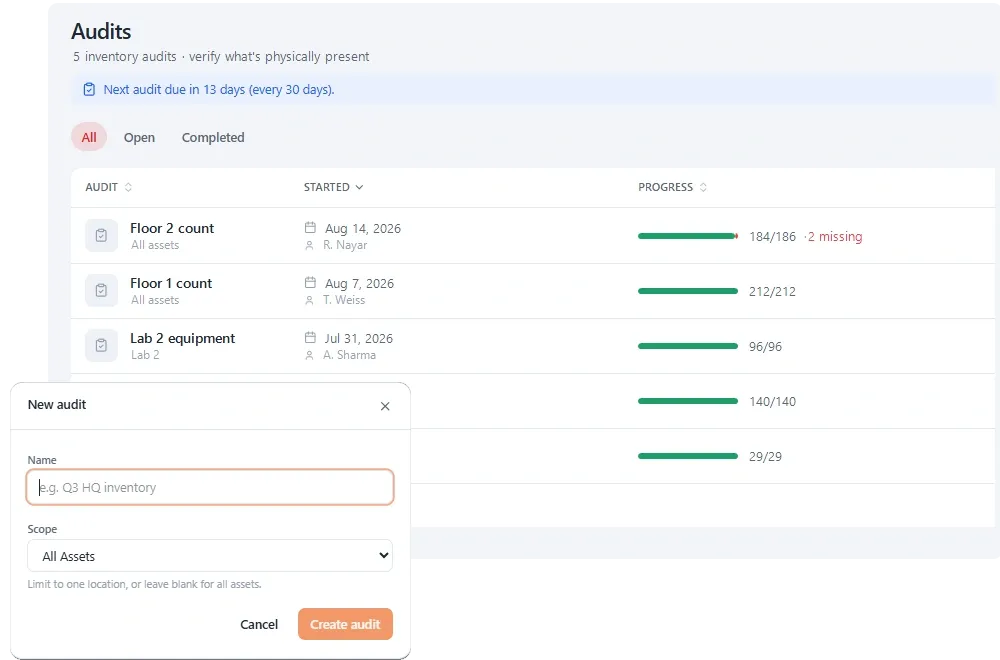
*A scoped audit in Stackroom, with verified and missing counts per audit.*
If you run counts in Stackroom, each audit is scoped to a location or group of assets, and every item is marked verified or missing with notes. The app records where each check was actually taken, and the audit closes with a note. Report templates cover audit summaries, items missing at audit, coverage by site and assets not yet checked, which is most of the evidence pack above. The audits and compliance page has more detail.
Printable asset audit checklist
Before the count
- Write down the scope: locations, asset classes, value bands and exclusions.
- Export and save the register snapshot for the scope.
- Set the cut-off rule for issues, returns, transfers and disposals during the count.
- Assign counters who are not the custodians of the area they count, in pairs where possible.
- Confirm access to every room, cupboard and cabinet; bring spare tags.
- Arrange verification for assets held by remote or travelling staff.
- Choose which items to count in full (high-value, high-risk) and how to sample the rest.
During the count
- Count blind: record everything present rather than ticking a list.
- Record the actual location, condition and holder for every item.
- Tag and photograph anything without a tag; note its serial number.
- Run a floor-to-register check as well as a register-to-floor check.
- Log any movement that happens during the count with a time.
After the count
- Compare the count to the register snapshot and list every discrepancy.
- Classify each one: missing, found, wrong location, wrong custodian, wrong status.
- Investigate missing items against custody records before writing anything off.
- Get approval for write-offs and record disposal date, method and carrying amount.
- Add found items that meet the capitalisation policy, at cost.
- Update the register, post journals, and agree register totals to the general ledger.
- Write the summary: scope, date, counters, verified, discrepancies, actions.
- File the evidence pack with the year's accounting records.
- Schedule the next count, and fix the process behind the biggest cluster of discrepancies.
Sources
- Ghost assets can haunt companies for years — Accounting Today, 2019
- Invisible risks, measurable returns: the fixed asset register — Kroll, 2025
- AS 2315: Audit Sampling — PCAOB
- ISA (UK) 530 Audit Sampling — Financial Reporting Council, 2025
- 2 CFR 200.313 Equipment — eCFR, current
- Final Rule: Management's Report on Internal Control Over Financial Reporting, Release 33-8238 — SEC, 2003
- FRS 102 (September 2024 edition) — Financial Reporting Council, 2024
- IFRS at a glance: IAS 16 Property, Plant and Equipment — BDO
- How long should I keep records? — Internal Revenue Service
- Company and accounting records — GOV.UK
Key takeaways
- A physical count tests existence (register to floor) and completeness (floor to register); plan for both directions.
- Count blind and record where each item was actually found, so moved assets show as one finding instead of two.
- Widely quoted ghost asset percentages trace back to vendor estimates, not published studies; your own count is the only reliable number.
- Every discrepancy needs a classification and an outcome, and write-offs need a disposal record and a ledger journal.
- US federal award recipients must count equipment at least every two years; everyone else should set a cadence they will actually keep.
Frequently asked questions
What is a physical inventory count of fixed assets?
A physical inventory count, or asset audit, is a dated check that the assets on your fixed asset register physically exist, are where the register says, and are held by the recorded person, plus a check for assets that exist but are not recorded. The output is a list of verified items and discrepancies, corrections to the register, and any write-offs posted to the general ledger.
How often should you do a fixed asset physical count?
There is no single rule for private businesses. US recipients of federal awards must count equipment and reconcile it to property records at least once every two years under 2 CFR 200.313. Many organisations run an annual full count; others run rolling cycle counts by location or category so everything is covered over the year and discrepancies are found sooner, while they can still be traced.
What is a blind count in an asset audit?
A blind count means the counter records every asset they find in a location without being shown the list of what should be there. The comparison with the register happens afterwards. It avoids the main weakness of checklist counts, where people tick items they assume are present. In scanning apps, the equivalent is scanning everything in the room rather than working down a pre-loaded list.
What are ghost assets, and how common are they?
Ghost assets are records on a fixed asset register for items that no longer exist or cannot be found, for example because they were lost, scrapped or sold without the register being updated. Figures of 10% to 30% of a register are widely quoted, often attributed to Gartner or advisory firms, but no published study with a methodology has been identified, so treat them as estimates.
How do you handle missing assets found during an audit?
First check custody records and ask the last recorded holder, then search nearby locations. If the asset is still missing after a set period, approve a write-off and record the disposal date, method such as lost or stolen, and carrying amount, then post the journal so the register and ledger agree. Record where and when it was last seen, because clusters reveal process gaps.
Can you use sampling instead of counting every asset?
Yes, for interim checks, and external auditors often test samples. Audit standards such as PCAOB AS 2315 and ISA (UK) 530 define sampling as testing less than 100% of items, with every item having a chance of selection. A practical approach is to count high-value items in full, sample the rest randomly or systematically, and switch to a full count wherever the sample finds too many problems.