


Getting equipment back from remote employees works when the return starts on the day notice is given, not the last day: a generated list of what they hold, a prepaid return kit, a dated deadline with reminders, inspection on arrival and a recorded data wipe. Pay deductions are tightly limited in the US and UK, so prevention beats recovery.
To get equipment back from a remote leaver, you need a process designed before anyone resigns. In an office, the laptop usually comes back because the person walks past the IT desk on their last day. When someone leaves a remote job, nothing walks past anything. The kit is in a spare bedroom two states or two countries away.
Plenty of employers now face this. In the US, 22.6% of workers teleworked or worked at home for pay in March 2026, according to the Bureau of Labor Statistics. Across Great Britain, 28% of working adults hybrid worked between January and March 2025, the Office for National Statistics found. Each of them has equipment at home that will one day need to come back.
How much equipment actually goes missing?
Good independent data on this is thin, so treat what follows with care. The most-cited figure comes from a vendor survey: Capterra, a software review marketplace, surveyed 287 HR employees who handle offboarding in November 2022. Of those, 71% said at least one departing employee in the past year hadn't returned company-owned equipment such as a laptop or smartphone. Those who kept equipment walked away with $1,963 of it on average, and hybrid or remote employees were 17% more likely not to return equipment than on-site staff.
The same survey found that 59% of respondents whose departing employees kept equipment said it held sensitive information, and only 55% could completely lock the former employee out of the device. That second number is the one to worry about. You can buy another laptop, but you can't take back the data that left on the old one.
You'll find other figures online, such as recovery rates of 50%, 70% or 95%, mostly on the blogs of companies that sell device retrieval services. We couldn't trace those to a published methodology, so they're not repeated here. What the survey does support is narrower, and still enough to act on: a meaningful share of remote leavers don't return everything, and the people running offboarding say so.
Why remote returns fail
Almost nobody plans to keep a company laptop. Returns fail for duller reasons:
- Nobody has the list. IT knows about the laptop. Nobody remembers the monitor, the dock, the headset or the second charger shipped six months later.
- The return starts too late. It's raised on the last day, by which point the person has mentally left and their manager has moved on.
- The return is the employee's problem to solve. Asking someone to find a box, print a label and queue at a post office is asking them to do unpaid admin for an employer they're leaving.
- There's no date. 'Please send it back when you can' has no deadline, so it never becomes overdue.
- Nobody checks what arrived. A box comes back, gets put in a cupboard, and three months later someone discovers the charger was missing and the screen was cracked.
The return process, step by step
1. Trigger the return the day notice is given
Start when HR records the leaving date, not on the last working day. At that point the person is still on payroll and still answering messages, and there is time to post a kit and get it back before their access ends. Wire this into the leaver process so IT or operations hears about it automatically. If it relies on a manager remembering to forward an email, it will fail in exactly the busy weeks when it matters.
2. Generate the list from the record
Send the leaver an itemised list of everything recorded against their name: make, model, serial number or asset tag, and accessories. A list prevents most disputes before they start, because the person can see precisely what is expected and say early if something was never received. It only works if issuing was recorded properly in the first place, which our guide to onboarding and offboarding equipment covers.
3. Send a prepaid return kit
Make returning easier than keeping. A return kit is a box sized for the equipment, protective packaging, a prepaid label and a one-page instruction sheet. Many organisations use a retrieval service; others ship their own. Either way, the employee should not pay anything or have to source packaging.
Laptops and phones contain lithium-ion batteries, which carriers regulate. In the US, for example, USPS sets out its rules in Publication 52, section 349: installed lithium-ion batteries must not exceed 100 Wh, and equipment must have an effective means of preventing it from being switched on in transit. Check your own carrier's rules before you design the kit, especially for cross-border returns.
4. Set a dated deadline and send reminders
Give a calendar date, not a duration, and set it before the last working day where you can. Then schedule reminders: one when the kit is delivered, one a few days before the deadline, one on the day, and an escalation when it passes. An unreturned item with a due date becomes overdue on a specific day; one without a due date just quietly stops being anyone's problem.
5. Inspect and check in each item on arrival
When the box arrives, open it within a day or two, check each item against the list, note condition and photograph anything damaged. Check items in individually rather than closing the whole record in one go, so a missing charger stays visible as outstanding. Tell the leaver promptly what arrived and what didn't, while they can still look for it.
6. Wipe the data and record that you did
A returned laptop holds the former employee's work files, cached credentials and often personal data about customers and colleagues. Sanitise it before reissue, and record the method, the date and who did it. NIST's SP 800-88 Revision 2, published in September 2025, recommends completing a certificate of sanitisation for each item, recording details such as the serial number, the method (clear, purge or destroy), the tool used and who verified it (NIST SP 800-88r2, section 4.6).
7. Close the record or escalate
Once everything is back and wiped, close the custody record with the return date and condition. If something is still outstanding after the final deadline, record it as unreturned against the person rather than deleting it, decide whether to lock or wipe the device remotely, and decide whether the loss needs a data-protection assessment (more on that below).
A sample return timeline
Say an employee gives four weeks' notice. The intervals below are suggestions; adjust them to your own notice periods and carriers.
|
When |
Action |
Owner |
Record kept |
|---|---|---|---|
|
Notice day (day 0) |
Leaver flagged; list of held items generated |
HR triggers, IT/ops owns |
Leaving date, item list sent |
|
Day 1–3 |
Leaver confirms the list or flags discrepancies |
Leaver |
Confirmation or dispute noted |
|
Day 5–7 |
Prepaid return kit dispatched |
IT/ops |
Tracking number |
|
Kit delivered |
Reminder with return date and instructions |
IT/ops |
Delivery confirmation |
|
5 days before last day |
Reminder: return due date approaching |
Automated |
Reminder sent |
|
Last working day (or earlier) |
Return due; accounts disabled |
IT |
Return tracking or overdue flag |
|
Arrival + 1–2 days |
Inspect, check in each item, note condition |
IT/ops |
Per-item return with condition and photos |
|
Arrival + 1 week |
Sanitise; certificate of sanitisation |
IT |
Method, tool, date, operator |
|
Due date + 7 days |
Escalate to HR; consider remote lock or wipe |
HR / IT |
Escalation logged |
|
Due date + 30 days |
Record as unreturned; assess data risk |
IT / data protection lead |
Close reason: lost or not returned |
The legal side: can you deduct the cost from final pay?
Every finance team asks this. You can do it far less often than they'd like. What follows summarises published government guidance and is not legal advice. Rules change and depend on the facts, so check the law where your employee works and take advice before deducting anything.
United States: federal floor, state rules on top
At federal level, the Department of Labor's Fact Sheet #16 says employers may not make deductions for items that are primarily for the employer's benefit (it lists tools, damage to the employer's property and theft of the employer's property) if doing so would reduce the employee's wages below the minimum wage or overtime pay required by the Fair Labor Standards Act. For most salaried remote employees, the FLSA floor is not the binding constraint. State law is.
State rules vary widely. California is a well-known example of a strict approach: its Labor Commissioner's office says an employer cannot deduct from wages for breakage or loss of equipment that happens through mistake or accident. The wage orders allow a deduction only where the loss was caused by a dishonest or wilful act or gross negligence, a simple accusation isn't enough, and the office cautions that even this exception may not comply with the Labor Code and court decisions. Final pay timing is also a state matter: the DOL notes that federal law doesn't require immediate final pay, but some states do. Check the rules in the state where the employee works, which may not be the state your head office is in.
United Kingdom: written terms or written consent, in advance
In the UK, deductions are governed by Part II of the Employment Rights Act 1996. Section 13 says an employer may not make a deduction unless it is required or authorised by statute or by a relevant provision of the worker's contract, or the worker has previously agreed to it in writing. Consent given after the event doesn't authorise a deduction for conduct that happened before it.
Government guidance puts it plainly: your employer may deduct pay only if it's required or allowed by law, you agree in writing, or your contract says they can. Acas guidance says the same. A worker who believes a deduction was unlawful can go to an employment tribunal. So if you want any right to recover the cost of unreturned equipment, put it in the contract or a signed agreement before the equipment is issued.
European Union: the bigger issue is the data
Wage deduction rules differ between EU member states, so check national law locally. What applies everywhere in the EU (and in the UK under UK GDPR) is data protection. A laptop that doesn't come back is a device full of personal data outside your control.
Article 32 of the GDPR requires controllers to implement appropriate technical and organisational measures to ensure a level of security appropriate to the risk, including encryption where appropriate. If a device holding personal data is lost and that loss is likely to result in a risk to people, Article 33 requires notifying the supervisory authority without undue delay and, where feasible, within 72 hours. The UK regulator, the ICO, lists computing devices containing personal data being lost or stolen as an example of a personal data breach, and says that even if you decide not to report, you must document why.
Here the wipe record earns its keep. If a regulator or auditor later asks what happened to a former employee's laptop, 'we think IT wiped it' is not an answer. A dated record of return, inspection and sanitisation is.
Why speed matters more than recovery
An older study makes the point well. Ponemon Institute's The Cost of a Lost Laptop, sponsored by Intel and published in 2009, analysed 138 lost-laptop cases across 29 US organisations. The average cost was $49,246, and a data breach accounted for 80% of it. Laptops discovered missing the same day averaged $8,950; those that took more than a week to notice averaged about $115,849. The figures are from 2009, so don't quote them as current costs. The direction still holds, though. Knowing quickly that something is overdue is worth more than chasing it later.
Return policy clause checklist
Your equipment policy and the agreement each employee signs should cover the return before anyone needs it. Our employee equipment agreement template and equipment policy template include clauses along these lines:
- Itemised schedule. The agreement lists each item with a serial number or asset tag, including accessories.
- Ownership. Equipment remains the organisation's property at all times.
- Return trigger and deadline. Equipment must be returned on or before the last working day, or within a stated number of days of a written request.
- Return method and cost. The organisation provides packaging and prepaid shipping; the employee packs and sends it.
- Condition. Items should come back in the condition issued, allowing for fair wear and tear.
- Data. The employee must not wipe, reimage or remove company data; the organisation sanitises returned devices.
- Personal data on company devices. Personal files are removed by the employee before return, or are deleted during sanitisation.
- Loss or damage. How loss, theft or damage must be reported, and how quickly.
- Cost recovery. Whether, and in what circumstances, the organisation may seek the cost of unreturned items, drafted to comply with the law where the employee works.
- Remote lock and wipe. That the organisation may lock or wipe a device that isn't returned.
- Signature and date. Signed at issue, not at exit. In the UK in particular, consent after the event doesn't authorise a deduction.
Making the record do the work
None of the steps above work unless you know what each person holds before they hand in their notice. If issuing is recorded properly, with each item against a named person, a signature and a due date, the return list writes itself.
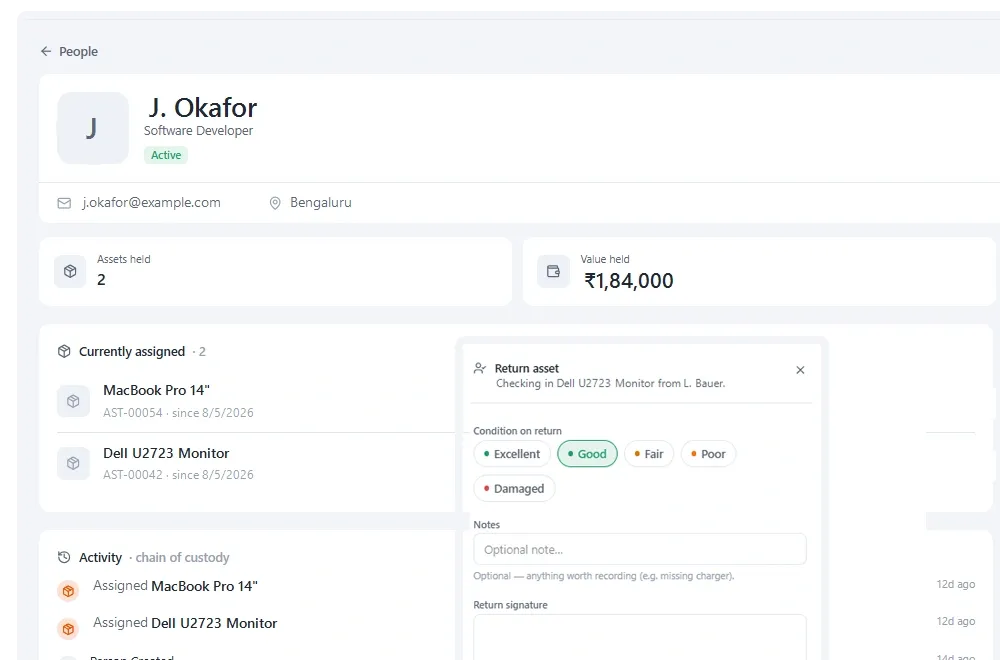
*Everything a leaver still holds, generated from their custody record.*
That's the job Stackroom is built for. Each item is checked out to a named person with a handover signature; an offboarding view lists everything a leaver still holds; returns are checked in item by item with condition and a return signature; and anything that doesn't come back can be closed as lost or stolen with the holder kept on the record. When everything is back, Stackroom can email a clearance certificate confirming the person has no outstanding equipment. It doesn't ship return kits or wipe devices (those stay with your carrier and IT tools), but it keeps the list, the dates and the evidence in one place.
For the wider picture, read our guides to remote and hybrid equipment management and to equipment for hybrid and remote teams.
Sources
- 22.6 percent of workers teleworked in March 2026 — US Bureau of Labor Statistics, 2026
- Who has access to hybrid work in Great Britain? — Office for National Statistics, 2025
- Employee offboarding survey (vendor survey) — Capterra, 2023
- Publication 52, section 349: Class 9 hazardous materials — USPS
- SP 800-88 Rev. 2, Guidelines for Media Sanitization — NIST, 2025
- SP 800-88r2 full text — NIST, 2025
- Fact Sheet #16: Deductions from wages for uniforms and other facilities under the FLSA — US Department of Labor
- Last paycheck — US Department of Labor
- Deductions FAQ — California Labor Commissioner's Office (DLSE)
- Employment Rights Act 1996, section 13 — legislation.gov.uk
- Deductions from your pay — GOV.UK
- Deductions from pay and wages — Acas
- GDPR Article 32: Security of processing — Regulation (EU) 2016/679
- GDPR Article 33: Notification of a personal data breach — Regulation (EU) 2016/679
- Personal data breaches: a guide — ICO
- The Cost of a Lost Laptop — Ponemon Institute for Intel, 2009
Key takeaways
- Start the return on the day notice is given, not the last working day.
- Send an itemised list generated from the custody record, including accessories.
- A prepaid return kit with a dated deadline and scheduled reminders makes returning easier than keeping.
- Check items in individually with condition notes, then record the data wipe with method, date and operator.
- US and UK law tightly limit pay deductions; in the UK they need contract terms or written consent in advance.
- Under GDPR, an unreturned device holding personal data may be a reportable breach, so document your assessment.
Frequently asked questions
How do I get a laptop back from a remote employee who has left?
Send an itemised list of what they hold, a prepaid return kit and a dated deadline, then follow up with reminders and an escalation to HR. If it still doesn't arrive, lock or wipe the device remotely if you can, record it as unreturned against the person, and assess whether the loss is a data-protection incident. Starting on notice day, not the last day, avoids most of this.
Can an employer deduct the cost of unreturned equipment from a final paycheck in the US?
Sometimes, but rules are strict and vary by state. Federally, the Department of Labor says deductions for employer-benefit items such as tools or damaged property can't take pay below minimum wage or required overtime. Some states go much further: California only allows such deductions in narrow cases like dishonest or wilful acts or gross negligence. Check the law in the employee's state and take advice.
Can a UK employer take money from wages for equipment that isn't returned?
Only if the deduction is authorised by law, by a written term of the employee's contract given to them beforehand, or by the employee's prior written agreement. Under section 13 of the Employment Rights Act 1996, consent given after the event doesn't cover earlier conduct. Unlawful deductions can be claimed back at an employment tribunal, so put the clause in the agreement signed at issue.
How long should a remote employee have to return company equipment?
There's no legal standard, so set a policy. A common approach is to require return by the last working day, ship a prepaid kit within a week of notice, and escalate seven days after the due date. Whatever you choose, use a specific calendar date rather than a vague duration, so the item becomes overdue on a known day.
Is a former employee's unreturned laptop a GDPR data breach?
It can be. The UK ICO lists lost or stolen devices containing personal data as an example of a personal data breach. Under GDPR Article 33, you must notify the supervisory authority within 72 hours where feasible if the breach is likely to risk people's rights. Encryption and remote wipe reduce that risk, and you should document your assessment either way.
What should an equipment return policy for remote workers include?
An itemised schedule of equipment, a clear return trigger and deadline, who pays for shipping, condition expectations, rules about not wiping company data, how loss or damage must be reported, whether and how costs may be recovered, and permission to lock or wipe unreturned devices. It should be signed when the equipment is issued, not when the person leaves.