
Maintenance & CMMS
Stackroom vs Brightly Asset Essentials
Brightly Asset Essentials (formerly Dude Solutions) is an established enterprise asset management platform, strong in education, government and healthcare facilities. Stackroom tracks movable equipment and who is holding it.
Stackroom vs Brightly Asset Essentials: which should you choose?
Brightly Asset Essentials is the better choice for facilities and infrastructure maintenance across buildings and grounds, particularly in education, government and healthcare. Stackroom is the better choice for the movable equipment inside those buildings — laptops, instruments, tools and AV gear that people borrow and return.
Side by side
Stackroom vs Brightly Asset Essentials: pricing, limits and features
Grouped so you can jump to the part you care about. Our figures come from our billing API, so they match the invoice.
Pricing & plans
Free plan
- Stackroom
- Free forever — 250 assets, 500 people, unlimited users, no card
- Brightly Asset Essentials
- None
Paid plans start at
- Stackroom
- $35/mo for Starter — published, self-serve
- Brightly Asset Essentials
- Not published.
How the bill scales
- Stackroom
- Capability and capacity — never headcount, never how much you track
- Brightly Asset Essentials
- Not published. Now sold under Siemens, with a demo request rather than a pricing page.
Limits
Asset limits
- Stackroom
- 250 free, up to 10,000 on Premium, custom on Enterprise
- Brightly Asset Essentials
- Not published
Users & seats
- Stackroom
- Unlimited on every plan, including Free — seats are never the meter
- Brightly Asset Essentials
- Not published
Locations & sites
- Stackroom
- 1 on Free, unlimited on every paid plan
- Brightly Asset Essentials
- Not published
How each tool is set up
Built around
- Stackroom
- Movable equipment & custody
- Brightly Asset Essentials
- Facilities & infrastructure
Time to first real use
- Stackroom
- Same day
- Brightly Asset Essentials
- Implementation project
Custody & accountability
Capital planning & asset condition
- Stackroom
- No
- Brightly Asset Essentials
- Yes
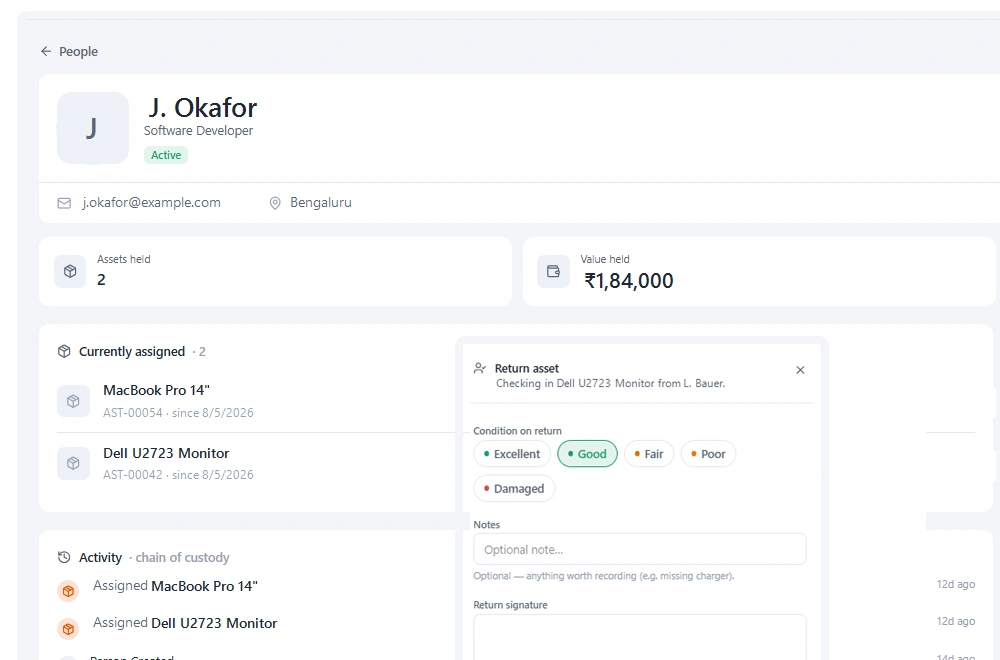
Signed handover & return, with PDF
- Stackroom
- Yes
- Brightly Asset Essentials
- No
Chain of custody history
- Stackroom
- Yes
- Brightly Asset Essentials
- Limited
Asset clearance certificate for leavers
- Stackroom
- Yes
- Brightly Asset Essentials
- No
Signed webhooks with retries
- Stackroom
- 41 events, HMAC-signed, retried
- Brightly Asset Essentials
- Not published
Audits & compliance
Cycle-count audits with sign-off
- Stackroom
- Yes
- Brightly Asset Essentials
- Inventory module
Maintenance & service
Facilities & infrastructure maintenance
- Stackroom
- No
- Brightly Asset Essentials
- Its strength
Finance & lifecycle
Depreciation (SLM / WDV) & book value
- Stackroom
- Yes
- Brightly Asset Essentials
- Yes
Tracking & tagging
Bookings & reservations
- Stackroom
- Yes
- Brightly Asset Essentials
- No
Platform, API & AI
Self-service requests for staff or students
- Stackroom
- Yes
- Brightly Asset Essentials
- Work requests
REST API
- Stackroom
- Pro and up — documented, published spec
- Brightly Asset Essentials
- Not published
Built-in AI assistant
- Stackroom
- Stackroom AI — Starter and up
- Brightly Asset Essentials
- AI-powered Maintenance Copilot
| Capability | Stackroom | Brightly Asset Essentials |
|---|---|---|
| Pricing & plans | ||
| Free plan | Free forever — 250 assets, 500 people, unlimited users, no card | None |
| Paid plans start at | $35/mo for Starter — published, self-serve | Not published. |
| How the bill scales | Capability and capacity — never headcount, never how much you track | Not published. Now sold under Siemens, with a demo request rather than a pricing page. |
| Limits | ||
| Asset limits | 250 free, up to 10,000 on Premium, custom on Enterprise | Not published |
| Users & seats | Unlimited on every plan, including Free — seats are never the meter | Not published |
| Locations & sites | 1 on Free, unlimited on every paid plan | Not published |
| How each tool is set up | ||
| Built around | Movable equipment & custody | Facilities & infrastructure |
| Time to first real use | Same day | Implementation project |
| Custody & accountability | ||
| Capital planning & asset condition | No | Yes |
| Signed handover & return, with PDF | Yes | No |
| Chain of custody history | Yes | Limited |
| Asset clearance certificate for leavers | Yes | No |
| Signed webhooks with retries | 41 events, HMAC-signed, retried | Not published |
| Audits & compliance | ||
| Cycle-count audits with sign-off | Yes | Inventory module |
| Maintenance & service | ||
| Facilities & infrastructure maintenance | No | Its strength |
| Finance & lifecycle | ||
| Depreciation (SLM / WDV) & book value | Yes | Yes |
| Tracking & tagging | ||
| Bookings & reservations | Yes | No |
| Platform, API & AI | ||
| Self-service requests for staff or students | Yes | Work requests |
| REST API | Pro and up — documented, published spec | Not published |
| Built-in AI assistant | Stackroom AI — Starter and up | AI-powered Maintenance Copilot |
Honest take: Brightly leads on facilities and infrastructure asset management at institutional scale. Stackroom leads on movable equipment custody. Many institutions need both.
Brightly Asset Essentials capabilities verified September 2026 · plan facts read from their pricing page , September 2026. Spotted something out of date? Tell us.
Plan gating
Which tier unlocks what
What you have to be paying for before each capability is available.
- CSV / XLSX importStarter and up
- Barcode & QR scanningStarter and up
- Bookings & reservationsStarter and up
- Maintenance & serviceStarter and up
- Cycle-count auditsGrowth and up
- Report libraryGrowth and up
- Custom fieldsGrowth and up
- Stackroom AIFree and up
- REST APIGrowth and up
- Signed webhooksGrowth and up
- Custom rolesGrowth and up
- Google / Microsoft SSOFree and up
- Nothing is published about tiering or limits
Brightly is procured the way institutional software is procured. Stackroom is procured the way a department buys a tool it needs this term.
The difference
What Stackroom and Brightly Asset Essentials are each built to do
Buildings versus what is inside them
Asset Essentials is about the estate: HVAC, boilers, roofs, grounds, vehicles, the work orders that keep them running, and the capital planning that decides what gets replaced when. In a school district, a council or a hospital, that is a large and important job and Brightly does it at institutional scale.
It has much less to say about the laptop trolley, the science department's instruments, the media school's cameras, or the ward's portable equipment. Those are movable, they are borrowed, they are returned, and they go missing — a different problem with a different shape.
Stackroom is built for that second category and does not attempt the first. We have no capital planning, no condition assessment, no facilities work-order management.
Why institutions end up with both
The facilities department buys Asset Essentials. Six months later the IT department, the science faculty and the media school each need to know who has their equipment, and discover that the facilities platform is neither designed for nor licensed for them.
What those departments need is quick to state: tag it, scan it, hand it to a named person with a signature, get it back, know what is booked next week, and be able to produce a count at year end. That is Stackroom's whole scope.
Departmental separation matters here. Stackroom's departments and configurable roles let each faculty or team manage its own equipment inside one organisation without seeing everyone else's — which is usually what makes a shared register politically acceptable.
Self-service borrowing
In education especially, the people borrowing equipment are students, and they are numerous, transient and not staff. A request-and-approve flow that a student can use from a phone, with the approval creating the custody record and the signature, is the difference between a system that works and a sign-out sheet on a clipboard.
An EAM's work-request flow is designed for reporting a broken radiator, not for borrowing a camera for the weekend. The shapes do not substitute.
Why teams switch
What we hear from teams leaving Brightly Asset Essentials
Departments could not get on the facilities system
Institutional EAM is licensed and configured for facilities. Other departments with equipment problems are structurally outside it.
Borrowing is not a work request
Lending a camera to a student and reporting a broken door are different flows, and an EAM only has the second.
Year-end counts needed evidence
Departments asked to produce an inventory need a scoped count with a signature, not a maintenance history.
The other side
When Brightly Asset Essentials is the better choice
We would rather you picked the right tool than picked ours.
- Your assets are buildings, grounds, plant and infrastructure.
- You need capital planning and asset condition assessment.
- You are running facilities maintenance at institutional scale with a work-order backlog.
- You need an established institutional vendor with procurement, implementation and training.
Switching
Moving from Brightly Asset Essentials
- 1
Export from Brightly Asset Essentials
Take a full CSV or XLSX export of your asset list, including serial numbers, categories, locations and any custom fields you rely on. Export your people list separately if Brightly Asset Essentials keeps one.
- 2
Map the columns once
The importer previews your file and lets you map each column to a Stackroom field. Categories, locations and departments are created from the values in your file, so you do not build the hierarchy by hand first.
- 3
Import people, then assets
Loading people first means custody assignments resolve to a real person on the asset import rather than needing a second pass.
- 4
Check a sample, then go
Spot-check twenty records against the old system before you invite the team. Re-importing is safe — matching on an existing code updates rather than duplicates.
Nothing is deleted from Brightly Asset Essentials by importing into Stackroom, so you can run both in parallel for a week while people get used to the change.
FAQ
Questions, answered
Should we replace Asset Essentials with Stackroom?
No. If it is managing your facilities maintenance, keep it — Stackroom does not do facilities maintenance. Add Stackroom for the movable equipment departments borrow and return.
Can each department manage its own equipment?
Yes. Departments and configurable roles mean a science faculty and a media school can each run their own register inside one organisation without seeing each other's equipment.
Can students borrow equipment themselves?
Yes. Requests go to whoever holds the approval permission, and approving creates the custody record. Handover captures a signature and generates a PDF agreement.
Does Stackroom do capital planning?
No. Purchase value, date and condition are recorded and export cleanly, but lifecycle capital planning is an EAM function and Brightly covers it.
Can we import our data from Brightly Asset Essentials?
Yes. Export your inventory to CSV and import it into Stackroom. Categories, locations and custom fields map across, and our team will help with the awkward parts of a larger migration.
How long does switching actually take?
Most teams import in the morning and run a real checkout the same afternoon. There is no implementation project and no professional services fee. The longest part is usually relabelling, and that can be done gradually.
Do we have to relabel everything?
No. If your existing labels carry a code you already track, import that code and keep using them. New QR labels can be printed on standard address stock as and when you need them.
Is Brightly Asset Essentials free?
No. Brightly Asset Essentials has no free plan. Stackroom has a permanent free plan with unlimited users and no card required.
How is Brightly Asset Essentials priced compared with Stackroom?
Not published. Now sold under Siemens, with a demo request rather than a pricing page. Stackroom prices on capability and capacity instead: users are unlimited on every plan, and tracking more equipment never moves the bill on its own.
What are the Brightly Asset Essentials asset and user limits?
Assets: Not published. Users: Not published. Locations: Not published. Every Stackroom limit is published on our pricing page and served from our billing API, so it matches your invoice.
Other comparisons
Looking at something else?
See all comparisons · Brightly Asset Essentials alternatives
Outgrowing Brightly Asset Essentials?
Import your data, print a sheet of labels, and run a real checkout the same day.