


A manufacturer warranty is the maker's promise against defects, included in the price. An extended warranty or service contract is separate cover you pay extra for, often adding onsite response or accidental damage. Underneath both sit statutory rights, which are strong for consumers but narrower for business buyers. Track each expiry so cover never overlaps or lapses.
Warranty, extended warranty and service contract get used interchangeably in purchase conversations, but they describe three different promises. They come from different parties, are paid for differently, cover different failures and, in the US at least, are treated differently by law.
Once you have them straight, you stop paying for cover you already have, and you know who to call when something breaks. This guide is written for organisations buying equipment in the US, UK and EU. If you buy in India or parts of Asia, the equivalent contracts are usually called an AMC (annual maintenance contract) or CMC (comprehensive maintenance contract); our AMC vs CMC vs warranty guide covers those terms.
The three types of cover, defined
Manufacturer warranty
A promise from the maker that the product is free from defects in materials and workmanship for a stated period. It comes with the product and is part of what you paid for. The US Federal Trade Commission's business guide to federal warranty law describes warranties as part of the “basis of the bargain”, with no extra charge.
Apple's US Mac warranty is a typical example. It covers hardware for one year from the original retail purchase, excludes accidental damage, liquid contact and cosmetic damage, excludes batteries that are designed to diminish over time unless they fail from a defect, and says a replacement part carries the remaining warranty or 90 days, whichever is longer.
Extended warranty
Cover you pay extra for that continues, and often widens, protection beyond the manufacturer warranty. It may come from the manufacturer or from a third party. In US federal law, despite the name, an extended warranty is generally a service contract: the FTC's consumer guidance says an extended warranty or service contract costs extra and is sold separately from the product.
Service contract or maintenance agreement
A paid agreement to repair, maintain or support equipment for a set term. The FTC distinguishes it from a warranty because it is either made after the sale or costs the buyer a fee beyond the purchase price. In business IT, this is usually where response-time commitments, onsite engineers and accidental damage sit. For workshop, lab and AV equipment, it often bundles scheduled servicing and calibration visits.
What the law adds underneath
Below any contract you buy sit statutory rights. They differ sharply between consumers and businesses, and most of the protections people quote apply to consumers only.
United States
The Magnuson-Moss Warranty Act governs written warranties on consumer products. The FTC is explicit that it does not apply to warranties on products sold for resale or for commercial purposes, and that it does not require anyone to offer a written warranty at all. Where it applies, 15 U.S.C. 2308 stops a supplier disclaiming implied warranties to a consumer if it gives a written warranty, or sells a service contract at the time of sale or within 90 days after.
Business purchases fall under state law based on the Uniform Commercial Code. UCC 2-314 implies a warranty of merchantability when the seller is a merchant in goods of that kind. But UCC 2-316 lets sellers exclude it, either with conspicuous written language that mentions merchantability, or with phrases like “as is” or “with all faults”. Read the terms on any refurbished or end-of-line purchase. Claims for breach of a sales contract must be brought within four years, and the contract can shorten that to as little as one.
United Kingdom
The Consumer Rights Act 2015 protects consumers, defined in section 2(3) as individuals acting wholly or mainly outside their trade, business, craft or profession. A company buying laptops is not a consumer. For consumers, trading standards guidance from Business Companion describes a 30-day short-term right to reject, a presumption that a fault found within six months was present at delivery, and up to six years to bring a claim in England and Wales.
Business-to-business sales of goods fall under the Sale of Goods Act 1979. Section 14(2) implies a term that goods sold in the course of a business are of satisfactory quality. A seller can exclude that term in a B2B contract only so far as the exclusion meets the reasonableness test in the Unfair Contract Terms Act 1977. The general time limit for a contract claim is six years under the Limitation Act 1980.
European Union
EU consumers get a minimum two-year legal guarantee on goods. If a defect appears within one year of delivery, the consumer does not have to prove it existed at delivery. A commercial guarantee from the seller or maker can add to this but can never reduce it. The underlying Sale of Goods Directive defines a consumer as a natural person acting outside their trade, business, craft or profession, so purchases by companies sit outside it and are governed by national contract law and the contract itself.
So when you buy as a business, don't count on consumer-style statutory rights. Your cover is largely whatever the warranty and your contracts say.
Enterprise support tiers, described generically
Business-class IT hardware is usually sold with a choice of support levels. The names differ by vendor, but the building blocks are similar:
- Depot or mail-in repair. You send the device away. Cheapest, slowest.
- Next-business-day (NBD) onsite. An engineer comes to you after remote diagnosis.
- Accidental damage protection. Covers drops and spills, usually with a cap on incidents.
- Keep your hard drive. You keep a failed drive rather than returning it, for data security.
- Priority or 24/7 phone support, sometimes with proactive monitoring.
Vendors differ in the fine print, and Dell's published ProSupport Plus for PCs service description shows what to look for. Its next-business-day onsite response follows remote diagnosis, is available five days a week, ten hours a day excluding holidays, and calls received after 5:00 PM local time may need an extra business day. Its accidental damage cover is limited to one qualified incident per device per twelve months, and excludes lost or stolen devices, damage from external fire and intentional damage. The same document states that it is not a contract for insurance.
None of that is unreasonable, but every line changes the value. “NBD onsite” bought for a laptop issued to a field worker who is never at a business address delivers less than it sounds. Accidental damage cover with one incident a year behaves very differently on a fleet issued to apprentices than on one issued to accountants.
Decision table: what each covers and when it is worth paying for
|
Cover |
Who provides it |
What it typically covers |
Typical term |
Worth paying for when… |
|---|---|---|---|---|
|
Manufacturer warranty |
The maker |
Defects in materials and workmanship; not accidental damage or wear |
Stated by the maker (one year on Apple Macs; one year on Dell batteries) |
Already included, so your job is to claim on it |
|
Extended warranty |
Maker, retailer or third party |
Continues defect cover, sometimes adds accidental damage |
Whatever you buy, usually from purchase |
The device will outlive the base warranty and repairs are costly |
|
Service contract / support plan |
Maker, reseller or service company |
Response times, onsite repair, accidental damage, servicing visits |
Fixed term, often renewable |
Downtime is expensive, or you lack in-house repair capacity |
|
Statutory rights (consumer) |
The law |
Goods must be of satisfactory quality and as described |
UK: up to 6 years to claim; EU: at least 2-year legal guarantee |
Free, but mostly do not apply to business purchases |
|
Statutory rights (business) |
The law and the contract |
Implied quality terms, subject to exclusion |
US UCC: 4 years, reducible to 1; England and Wales: 6 years |
Free, but check the contract has not excluded them |
The FTC's advice for consumers translates well to business buying: a service contract is not good value if it doesn't offer more than the warranty that came with the product. Check deductibles and per-claim fees, find out who actually backs the contract, and assume anything not listed is not covered.
Questions to ask before you sign a service contract
Most of the value in a service contract is decided by details that are easy to skim past in a sales conversation. Before signing, get written answers to these, and keep them with the contract.
- Who actually provides the service? The seller, the manufacturer or a third-party administrator. If the backer fails or is acquired, what happens to your cover?
- When does the term start? On the purchase date, on delivery, or when the manufacturer warranty ends. This decides whether year one duplicates cover you already have.
- What triggers a response, and when does the clock start? Many response commitments begin only after remote diagnosis, not when you first call.
- What hours and locations are covered? Business hours only, weekdays only, and only at a registered business address are common limits.
- What is excluded? Look for loss, theft, cosmetic damage, consumables such as batteries and lamps, software, and damage from misuse.
- Are there caps, deductibles or per-claim fees? An accidental damage benefit limited to one incident a year is very different from an unlimited one.
- Can you transfer or cancel it? If a device is reissued, sold or retired early, can the cover move with it or be refunded pro rata?
- What evidence do you need to claim? Serial number, proof of purchase, service history. If you cannot produce these quickly, the claim may be refused or delayed.
For workshop, lab and AV equipment, add two more: whether scheduled servicing or calibration visits are included, and whether the engineer's report will name the asset by its serial number so it can be filed against the right item.
Where overlapping cover hides
You will usually find overlap in one of three places.
- A multi-year plan that starts on purchase date. If the plan simply duplicates defect cover for the first year, you are paying for that year twice. Look for what the plan adds in year one: onsite response, accidental damage or both. If it adds nothing, it is overlap.
- An insurance policy or lease that already covers the device. Business insurance and leasing agreements sometimes include accidental damage or theft. Check before buying the same cover from the hardware vendor.
- Renewing cover on retired assets. Support contracts renew by serial number, and a device retired last quarter can easily stay on next year's renewal. Reconcile the renewal list against the asset register every time.
Worked example: overlap on a 50-laptop order
Worked example (hypothetical prices). An organisation buys 50 laptops with a one-year manufacturer warranty, and adds a three-year onsite support plan at $180 per device, $9,000 in total. In year one the plan duplicates the defect cover already in the warranty, and the only thing it adds is onsite response. For a mostly remote team that may be worth very little, which means roughly $3,000 of the $9,000 buys close to nothing. A depot-repair extension starting at month 13 might cover the same risk for less.
None of that makes the plan a bad buy. It means you should compare it year by year against what is already in place.
How to track expiry so cover never lapses or doubles up
Picking the wrong plan causes fewer problems than forgetting you have one at the moment something breaks. A device gets repaired at your expense because nobody checked, or a renewal goes through for equipment that left the business months ago.
- Record cover on the asset, not in a contracts folder. Kind of cover, provider, policy or contract number, start and end dates, and how to claim.
- Allow for one contract covering many assets. A fleet support plan is one contract across dozens of serial numbers.
- Keep the renewal history. When a contract renews, the new term should link to the old one so you can see the full cover timeline.
- Alert before expiry, not on it. Give yourself enough lead time to compare quotes, typically a couple of months for a fleet contract.
- Check cover at every repair decision. Before approving any repair spend, look at whether live cover applies.
- Review cover that is never claimed. A contract with no claims across its whole term may be insurance you did not need.
In Stackroom, cover is held against the asset with its kind (manufacturer, extended, AMC or CMC), provider, policy number, cost of cover, claim contact and terms. One contract can cover many assets, renewals keep their history, and alerts fire at two stages, as cover approaches expiry and when it expires. Reports include a cover register, cover never claimed and repairs claimed on cover. The maintenance and warranty page shows how cover and service tickets sit together.
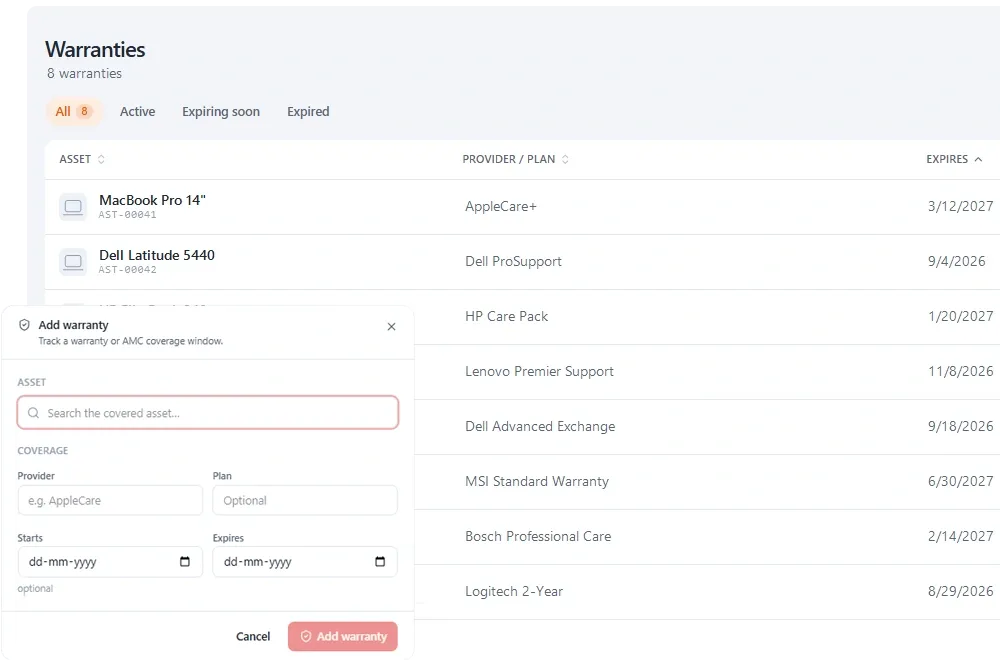
*Cover held against the asset: warranty and service contracts with providers, policy numbers and renewal dates.*
Cover status is also the first of the four facts in a repair-or-replace decision. If a repair is covered, most of that decision has been made for you.
Sources
- Businessperson's Guide to Federal Warranty Law — US Federal Trade Commission
- Warranties — US Federal Trade Commission, consumer advice
- Extended Warranties and Service Contracts — US Federal Trade Commission, consumer advice
- 15 U.S.C. 2308 Implied warranties — Legal Information Institute, Cornell Law School
- UCC 2-314 Implied warranty: merchantability — Legal Information Institute, Cornell Law School
- UCC 2-316 Exclusion or modification of warranties — Legal Information Institute, Cornell Law School
- UCC 2-725 Statute of limitations in contracts for sale — Legal Information Institute, Cornell Law School
- Consumer Rights Act 2015, section 2 — legislation.gov.uk
- Part 2. Consumer Rights Act — Business Companion (Chartered Trading Standards Institute)
- Sale of Goods Act 1979, section 14 — legislation.gov.uk
- Unfair Contract Terms Act 1977 — legislation.gov.uk
- Limitation Act 1980, section 5 — legislation.gov.uk
- Guarantees and returns — Your Europe, European Union
- Directive (EU) 2019/771, Article 2 — legislation.gov.uk, 2019
- Apple One Year Limited Warranty, Mac (US) — Apple
- Dell ProSupport Plus for PCs service description — Dell, 2024
Key takeaways
- A manufacturer warranty is included in the price; extended warranties and service contracts cost extra and are sold separately.
- Magnuson-Moss applies to consumer products, not to goods bought for commercial purposes.
- UK business buyers rely on the Sale of Goods Act 1979, not the Consumer Rights Act 2015.
- The EU's two-year legal guarantee protects consumers; company purchases fall under national contract law.
- Read service descriptions for response hours, incident caps and exclusions before paying for a tier.
- Hold cover on the asset record and reconcile renewals against retired assets to avoid paying twice.
Frequently asked questions
What is the difference between a warranty and a service contract?
A warranty comes with the product at no extra charge and is the maker's or seller's promise about its quality, usually covering defects for a set period. A service contract costs extra and is sold separately, either at purchase or later. The US Federal Trade Commission draws the line exactly there: service contracts are separate because they are made after the sale or cost an additional fee.
Is an extended warranty the same as a service contract?
In most practical and legal senses, yes. The FTC describes extended warranties and service contracts together as cover that costs extra and is sold separately from the product. The name “extended warranty” is a marketing term. What matters is who backs the contract, what it covers beyond the original warranty, and what fees, caps and exclusions apply.
Does the Consumer Rights Act apply to business purchases?
No. The Consumer Rights Act 2015 protects consumers, defined as individuals acting wholly or mainly outside their trade, business, craft or profession. Purchases by companies fall under the Sale of Goods Act 1979, which implies that goods are of satisfactory quality. In a business contract, that term can be excluded only so far as the exclusion is reasonable under the Unfair Contract Terms Act 1977.
Does the EU two-year guarantee cover businesses?
The EU minimum two-year legal guarantee protects consumers. The Sale of Goods Directive (EU) 2019/771 defines a consumer as a natural person acting outside their trade, business, craft or profession, so purchases made by companies fall outside it. Business buyers rely on the national contract law of the country concerned and on the warranty and contract terms they agree with the seller.
Does Magnuson-Moss apply to equipment a business buys?
Generally not. The FTC states that the Magnuson-Moss Warranty Act does not apply to warranties on products sold for resale or for commercial purposes. It covers consumer products, meaning tangible property normally used for personal, family or household purposes. Business purchases are governed by state law based on the Uniform Commercial Code, under which implied warranties can be excluded with conspicuous language or “as is” terms.
Is an extended warranty worth it for business laptops?
It depends on what it adds and when. The FTC notes a service contract is not good value if it offers no more than the warranty already included. For business laptops, the value usually lies in onsite response, accidental damage cover or keeping failed drives, not in duplicating defect cover. Compare it year by year against existing cover, and check incident caps and exclusions.